Custom Jewelry Development Guide
OEM vs ODM Jewelry Manufacturing: Which Route Fits Your Brand?
If you already have a technical design, your project is very different from a brand that only has a mood board. This guide explains OEM and ODM in practical buying terms, not factory jargon.
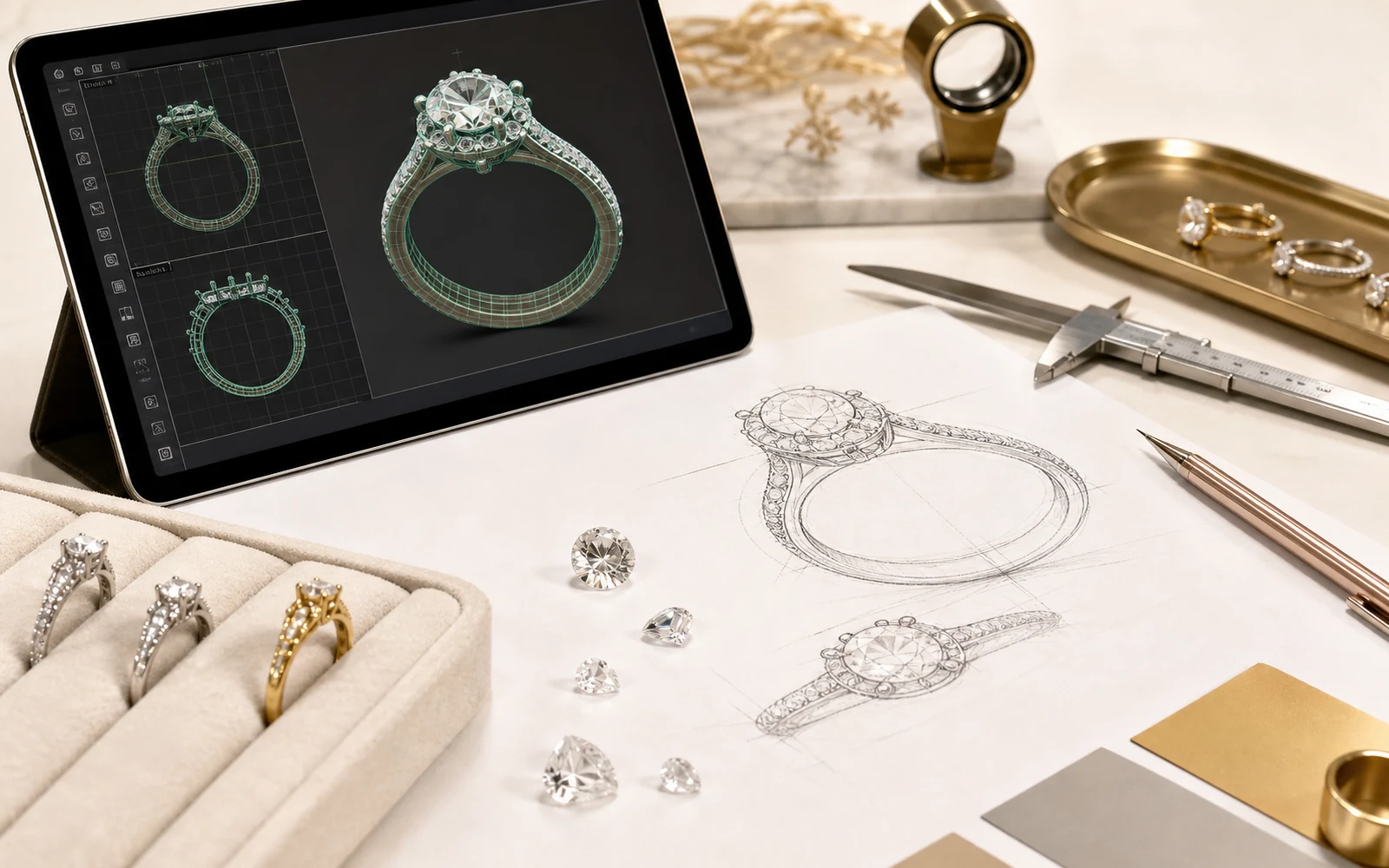
What you will get from this guide
- Understand the real difference between OEM and ODM.
- Match the development route to your starting point.
- See the usual drawing, sample and approval steps.
- Ask the right questions before paying for development.
The labels matter less than the workflow
Be clear about who supplies the design, which changes are included, and what must be approved before production.
Discuss Your ProjectOEM vs ODM Jewelry: The Simple Difference
With OEM jewelry manufacturing, the buyer normally brings a design, drawing or detailed specification and asks the supplier to produce it. With ODM jewelry, the supplier contributes more of the design direction, existing development or adaptation work.
In real projects, the line can overlap. A buyer may begin with an existing supplier design, change the stone layout and add branded packaging. The useful question is not only “Is this OEM or ODM?” but “Who provides the design, what changes are required, and who approves each stage?”
Which Route Fits Your Jewelry Brand?
| Situation | More suitable route | Reason |
|---|---|---|
| You have production-ready drawings | OEM | The design direction is already defined. |
| You have a mood board but no technical drawing | ODM or design support | The concept still needs development. |
| You want to change an existing product | Modified existing style | It may be simpler than a fully new project. |
| You need fast market testing | Ready stock first | You can validate demand before paying for development. |
Typical Development Steps
- Share the brief, reference and target market.
- Confirm material, dimensions, stones, finish and budget.
- Review drawing, CAD or selected existing style.
- Approve quotation and sample route.
- Inspect the sample and record revisions.
- Approve the final standard before bulk production.
Keep approvals in writing. Small changes to stone size, chain, plating or packaging can affect both cost and schedule.
Questions to Ask Before Starting
- Who provides the drawing or CAD?
- What is included in the sample charge?
- Is new tooling required?
- How many revision rounds are included?
- What is the MOQ after sample approval?
- How are design files and approved standards handled?
- Can the supplier support packaging and labeling?
Practical OEM and ODM Examples
| Brief | Likely route | What needs approval |
|---|---|---|
| Add branded packaging to an existing necklace | Private label | Product, artwork and packaging sample |
| Change CZ color and chain length | Modified existing design | Compatibility, sample and revised price |
| Create a ring from your technical drawing | OEM | CAD, dimensions, sample and fit |
| Develop a collection from a mood board | ODM or design support | Concept selection, drawings and samples |
Which Example Fits a Small Brand?
If the product concept is still untested, begin with existing or lightly modified styles. Once customers show clear interest in a shape or collection, invest in a more exclusive design. This keeps early cash tied to sellable inventory rather than too many development projects.
A brand with a proven bestseller and clear drawings may be ready for OEM. A brand with a strong customer profile but no technical design team may benefit more from ODM support.
What a Useful Development Brief Includes
- Target customer, category and retail price.
- Reference images and the details you want to keep or change.
- Material, dimensions, stones and finish.
- Quantity, packaging and delivery target.
- Who supplies artwork, CAD and final approval.
Useful Pages for the Next Step
These pages continue the same buying journey without forcing unrelated product recommendations.
Buyer Procurement Notes
Buyer intent: decide whether to use ready-stock ODM styles or full OEM custom jewelry manufacturing. This decision usually comes down to speed, uniqueness, MOQ and development risk. ODM is better for fast testing; OEM is better when the brand has a specific product idea, stone layout or packaging direction.
Practical checks for this sourcing topic
- Use ODM when an existing style already fits your catalog.
- Use OEM when the structure, motif or stone layout must be unique.
- Separate product development cost from bulk order cost.
- Ask whether CAD or sample confirmation is required.
Use visible style, material and category words
| Style words | OEM jewelry manufacturer, ODM jewelry manufacturer, custom jewelry manufacturing |
| Best first test | ODM ready stock first, OEM after the winning direction is clear |
| Buyer question | Is this project better quoted as existing style adjustment or full custom development? |
OEM vs ODM Jewelry Manufacturing FAQ
What is OEM jewelry manufacturing?
The buyer normally provides the design or detailed specification for the supplier to produce.
What is ODM jewelry manufacturing?
The supplier contributes more of the design direction or adapts existing development.
Is modifying an existing style OEM?
It may be treated as a modification rather than a fully new OEM project.
Which is better for a new brand?
Ready stock or ODM support may be easier when the concept is not yet production-ready.
Do OEM projects need samples?
Yes, new designs should normally be sampled and approved before bulk production.
What affects custom MOQ?
Tooling, parts, stones, plating, packaging and production setup can all affect it.
Choose the Right Development Route
Send your drawings, references, target quantity and launch schedule for an OEM, ODM or existing-style review.
Request a Wholesale Quote